
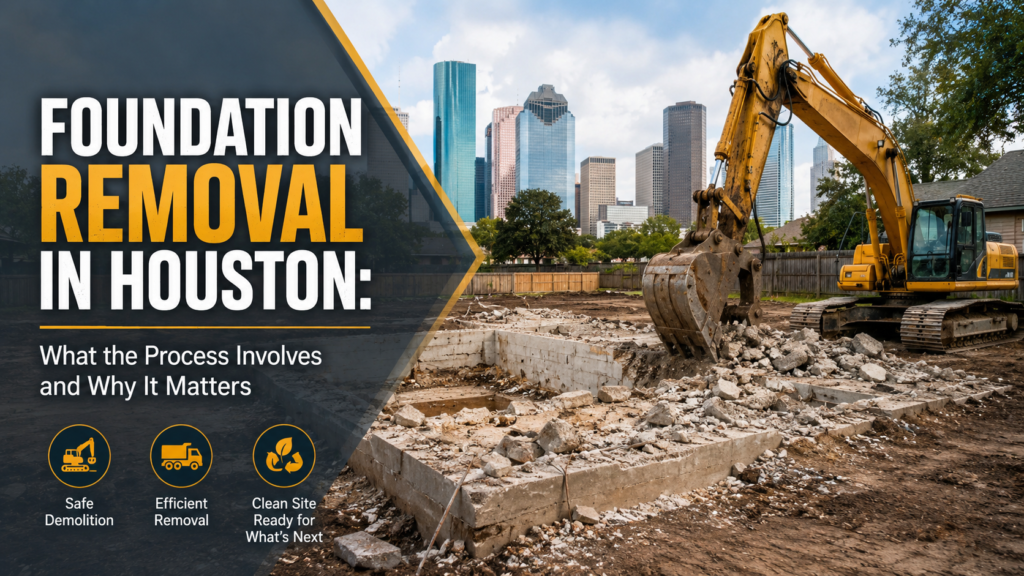
When a building is demolished in Houston, the work is rarely finished once the walls have come down. Beneath the surface lies the foundation the concrete slab, block walls, footings, or pier-and-beam system that once anchored the structure to the Texas soil and that must also be excavated and removed before any new use of the site can begin. Foundation Removal Houston is a distinct, technically demanding phase of demolition that requires specific equipment, subsurface knowledge, and an understanding of Houston’s unique soil conditions.
Houston’s Unique Foundation Landscape
Houston sits atop one of the most challenging soil environments in the United States. The region’s clay-rich subsoil known as expansive clay or “black gumbo” is notorious for its behavior under changing moisture conditions. When saturated after heavy rains, it swells significantly; when it dries out during hot Texas summers, it contracts. This persistent cycle of expansion and contraction is the primary driver of Houston’s high rate of foundation movement, cracking, and settlement.
Because of this soil behavior, Houston builders have historically relied primarily on two foundation types: slab-on-grade (by far the most common in modern construction) and pier-and-beam (more common in older homes in neighborhoods like the Heights, Montrose, and other inner-loop communities built before the 1960s). Each presents different characteristics and removal considerations.
Slab-on-grade foundations are monolithic concrete pours sometimes with post-tensioned cables running through them for additional strength that sit directly on the prepared subgrade. Their removal involves breaking the concrete slab, extracting any embedded steel or cable, and clearing the resulting material. Post-tensioned slabs require particular care because the steel cables running through them are under tension cutting a post-tensioned cable while it remains stressed can cause a violent release of energy, and experienced contractors identify these slabs and plan their demolition approach accordingly.
Pier-and-beam foundations use a network of concrete or masonry piers supporting wooden beams, with the structure elevated above a crawl space. Removal of these foundations involves pulling or breaking the piers, removing the beam members, and addressing any concrete grade beams that connect the pier heads. Older Houston pier-and-beam foundations sometimes include brick or stone masonry piers that predate concrete construction.
Why Foundation Removal Is Necessary
Property owners sometimes wonder whether foundation removal is strictly required when a building is being replaced. For new construction, building over existing foundation remnants creates significant structural risk. An old concrete slab takes up volume beneath grade that should be occupied by engineered fill or the new foundation system. Old concrete reacts differently to soil movement than engineered subgrade, creating differential settlement that causes new construction to crack and shift. Texas building standards universally require clean, properly prepared subgrade for any new structure which means existing foundations must be fully removed.
Houston’s drainage-sensitive environment provides additional motivation. Buried foundation remnants can obstruct subsurface drainage paths, interfere with utility installation, and create uneven subsidence over time. For lots being cleared for green space, urban agriculture, or surface uses, buried concrete creates ongoing hazards. Environmental and permit requirements in Harris County and the City of Houston also govern demolition debris disposal, making professional management of foundation removal an important part of project compliance.
The Foundation Removal Process in Houston
Foundation removal follows a structured sequence. After the above-grade structure has been demolished and cleared, the contractor assesses the foundation scope type, dimensions, depth, reinforcement, and any special features such as grade beams or underground utility connections that penetrate through the slab.
For slab-on-grade foundations, removal begins with systematic concrete breaking using hydraulic breaker attachments on excavators. The breaker fractures the slab into manageable sections that are grabbed, loaded, and hauled away. Rebar is separated from the broken concrete during loading steel is typically recycled through scrap metal channels, providing some economic offset to the removal cost. For post-tensioned slabs, the contractor identifies anchorage pockets and determines the tendon layout before planning a breaking sequence that manages the tension release safely.
For pier-and-beam foundations, removal involves excavating around and between individual pier elements, extracting or breaking each pier, and removing the resulting material. Wooden beam members are removed, sorted, and either recycled or disposed of through appropriate channels.
After all structural elements are removed, the excavation is backfilled with clean, compactable material placed in controlled lifts and compacted to achieve the density needed to support future surface uses. Proper backfill is essential in Houston because of the soil’s expansive behavior the clay surrounding the former foundation void will expand and contract with moisture, and if the void is not properly filled and compacted, differential settlement will affect the finished surface.
Houston Regulatory Considerations
Foundation removal as part of a larger demolition project requires compliance with City of Houston and Harris County permit requirements. The Department of Neighborhoods manages residential demolition permits; commercial demolition coordinates with the Development Services Department. Asbestos survey is required for any structure built before 1980 per TCEQ rules, and Harris County Flood Control District regulations govern site drainage during and after foundation removal work. Experienced local contractors manage these regulatory interfaces as part of their standard project scope.
Common Questions About Foundation Removal in Houston
Does a slab need to be removed if I am building in the same footprint? Generally yes. Engineering requirements for new construction call for removal of existing concrete and proper subgrade preparation rather than building over existing slabs. Your structural engineer of record will specify what is required for your particular project.
What happens to the concrete from foundation removal? Concrete is frequently recycled as crushed aggregate for use in road base, fill applications, and other construction purposes in the Houston market, reducing landfill disposal costs and providing a productive second use for the material.
How deep must foundation removal go? All structural concrete elements must be removed. For development projects, the geotechnical engineer’s recommendations for subgrade preparation depth govern. For simpler uses, complete removal to the bottom of the existing footing is the standard approach.